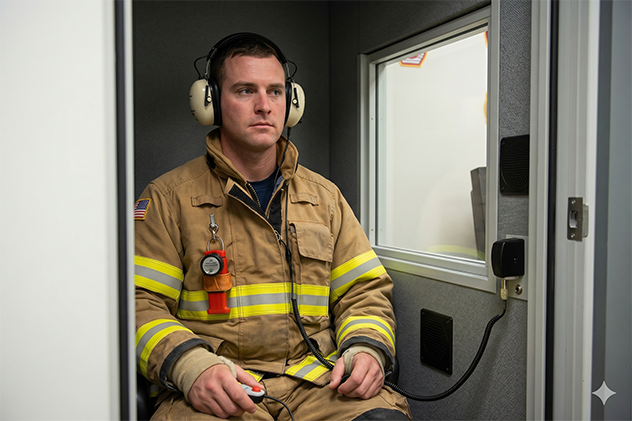
Curious about how do diagnostic hearing tests work for children? Discover the essential steps that help identify hearing loss and support your child’s future.
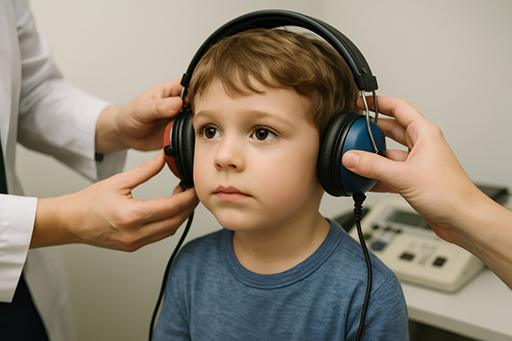
Hearing loss can get in the way of your child’s ability to learn good social skills. A hearing test is important because it checks how well your child can hear. It helps find any hearing problems early. When you know what is wrong, you can find ways to help fix it. A hearing test, like a newborn hearing screening or one for older children, always tries to spot problems as soon as possible. These hearing screenings show what kind of hearing loss is there and how bad it is. They also help you make a plan so your child can have better hearing and get the best results.
Understanding Hearing Loss in Children
Hearing loss in children can be caused by different things. Some kids have problems like a blocked outer ear, ear infections in the middle ear, or damage to hair cells in the inner ear. These hair cells send sound signals to the brain. When they are hurt, it can be hard for a child to talk, hear, or learn.
There are three types of hearing loss: conductive, sensorineural, and mixed. Each type affects the ear in its own way. A doctor needs to know the type your child has. This will help give the best care.
Common signs of hearing difficulties
You may notice that your child has trouble hearing. There are some things they do that can show this. If you notice these signs early, it can help your child get support sooner.
- Turning up the TV volume too high: When someone keeps the TV volume too high, it may show that they do not hear things the way other people do.
- Not responding to loud noises: If your baby does not look at or move towards loud noises, it can be a sign of hearing loss.
- Unclear speech: If you and other people find it hard to understand what your child says, it might be that they do not get all the sounds right.
- Frequently saying “Huh” or asking for repetition: If your child often says “Huh” or asks people to repeat, it can mean they are not hearing words clearly.
- Learning difficulties: A child that does not do well in school may have trouble with hearing and talking. This can be because of hearing loss and makes it hard to pick up what is being said.
Kids with hearing impairment may also spend less time with other people. So, do not just look at how your child reacts to sound. You should also pay attention to these ways they act.
Effects of undiagnosed hearing loss on development
Hearing impairment can have a big effect on a child’s growth. It can make it hard for them to learn new words that people speak. This can slow down their language development. A child with hearing loss may also find it hard to build good social skills. These problems can bring down their quality of life.
If no one notices hearing loss in time, the child may feel alone. Their confidence can go down, and they may have a hard time making or keeping friends. These things can hurt how they feel every day. A child may find it tough to understand their teachers. They may not take part much in class. All this can slow down how well and how fast they grow.
It is important to spot hearing loss early. If parents and teachers know what to look for, they can act before things get too bad. Early help gives children the best chance to grow well. It can make their language development and social skills better and boost their quality of life.
Why Early Diagnosis Matters
Spotting hearing problems early can make a big change in your child’s life. A hearing screening done at birth or when your child is still young will help your child get help fast. If you wait too long, your child may have trouble with talking, learning, or being around other people.
The best way to handle hearing impairment is to have checks and get treatments as soon as you can. When you find out early, your child can use things like hearing aids or other types of support. This helps keep your child healthy. It can also give them a better shot at doing well in life. When you take action and check any worries you have about your child’s hearing, you help give them a good chance to succeed.
The impact of early intervention
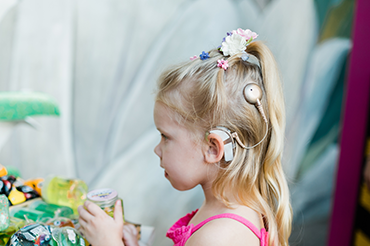
Early intervention is very important for children who have hearing loss. Hearing aids help make sounds louder. This lets them take part in talks and enjoy social activities. If the hearing loss is very bad, cochlear implants can help by sending sound right to the brain. When help comes early, it lowers the risk of language development problems. Children can hear speech and grow their word skills. This will make sure hearing impairment does not stop them from learning or making friends. No matter what method you use, early help is important for a child’s progress. If you think a child has hearing loss, see a specialist right away, as this can really help improve their life.
Risks of delayed hearing assessment
Delaying a hearing evaluation for your child can lead to permanent hearing loss and other issues, making it crucial to address them early. A hearing evaluation can help catch these problems early, ensuring your child’s safety. If not addressed, your child may struggle with academic performance and social interactions. Missing words in class can make learning difficult and affect their ability to get along with others. Early medical treatment for hearing loss, such as hearing aids or surgery, can significantly improve a child’s quality of life. Waiting too long may result in missed care, affecting their self-esteem and confidence.
Types of Diagnostic Hearing Tests for Children
Hearing tests vary depending on a child’s age and ability to work with the test giver. Objective tests like OAE or ABR measure brain and nerve reactions to sound, while behavioral tests like pure tone audiometry and speech tests require more involvement from the child. These evaluations focus on the child’s own hearing problems.
Choosing the right hearing test is crucial for accurate results, as it helps find answers that are appropriate for the child, regardless of their age or hearing problem. These tests measure brain and nerve reactions to sound and are generally less demanding than behavioral tests.
Objective tests (OAE, ABR) explained
Otoacoustic emissions (OAE) and auditory brainstem response (ABR) tests are good ways to check a child’s hearing. The OAE test looks at the sound that hair cells in the inner ear make. If this sound is there, it often means the child has normal hearing. The ABR test checks how the auditory nerve reacts when it hears sounds. This test helps you and the doctor learn what types of hearing loss a child may have, like conductive hearing loss or sensorineural hearing loss. Both tests do not hurt, and they are simple to use for newborns and young children. Testing a child’s hearing early can help find hearing loss soon. This helps you and your child get the right help, and it can be good for the child’s language development.
Behavioural hearing tests for different age groups
Behavioral tests are used to see how your child reacts to sound. In these tests, your child will need to respond in some way. You can use these tests with kids at any age.
Here’s a look at how these tests work for every child’s age:
- Infants and toddlers: The test uses a visual reward, like a moving toy, to get the child to respond to sounds. This helps keep their attention.
- Preschool children: The test turns into a game, like putting blocks in a box every time the child hears a sound. This makes it fun and keeps them interested.
- Older kids: They use tests like pure tone and speech tests, for example, pure tone audiometry. These help see if your child can hear different tones or know words apart.
- Bone conduction methods: These tests are used when a more detailed check is needed. They send sound right through the bones to see how well your child hears this way.
All these ways to test match well with the child’s age and what they are able to do. This helps parents feel sure that their child gets a good and fair exam each time.
What to Expect During a Child’s Hearing Test
Walking into a hearing assessment for your child can feel a bit tough. But, when you know what will happen, it can help you feel at ease. These hearing tests use several checks to look at different parts of your child’s hearing system.
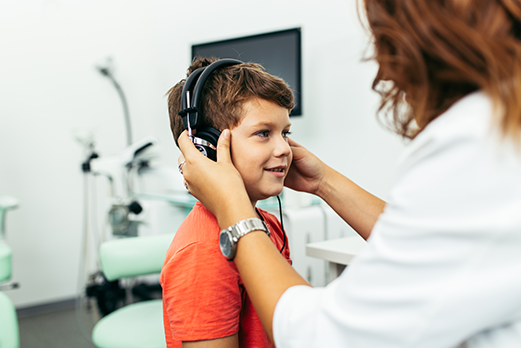
Audiologists put small devices in the ear canal. They also use sound games that are fun. These tests are made to fit your child’s age and what they can do. It is good to get your child ready before the visit. This can help the tests go well and give more exact results. Your child will learn more about sounds and how we hear things in the world.
Preparing your child for the appointment
To get your child ready for the hearing test, it is good to help them feel calm and willing to work with the staff. Keep these things in mind:
- Explain in simple words: Tell them what is going to happen. Do this so they do not feel fear or worry about the visit.
- Give them practice with headphones: Let them use headphones at home. This way, they will know what to expect on the day of the test.
- Avoid loud sounds: Keep your child away from loud sounds before the visit. This helps them feel calm and not get upset.
- Schedule thoughtfully: Choose a time when your child is rested and feels good for the visit.
- Consult your primary care provider: Talk to your primary care provider. Ask if they have any tips for your child’s needs or how they act.
A good and happy place can make the hearing test nicer for you and your child. If your child feels good and safe, the hearing test visit can go well for both of you.
Step-by-step process on test day
On the day of the hearing test, professionals do a few things:
- Begin with small devices that go in the ear canal. This helps start the early tests for young children.
- Introduce different sounds. These sounds can be loud or soft, and the tones can change as well.
- Monitor eardrum movement. They use air and sound to see how the eardrum moves and to make tympanograms from this.
- Track brain responses. Sensors help follow how sounds go from the ear, through nerves, and all the way to the brain.
- Include fun elements. Visual rewards keep young children interested each time.
- Adapt based on the child’s responses. They change each step to match what the child can do at that time.
Audiologists use child-friendly ways to give hearing tests to young children. They make the test feel full and fun. This helps young children feel good and enjoy the hearing test.
Interpreting Results and Next Steps
When your child has a hearing test, it shows the type and how much hearing loss there is. This helps the audiologist know what is best for your child’s hearing. With this clear info, you can get good treatments. Some of these will be medical help, hearing aids, or cochlear implants.
It is important to keep up with follow-ups after that. The visits help your child get used to the hearing aids or cochlear implants. Good follow-up gives your child the best chance to talk again and connect with other people. Taking each step will help your child grow and build a healthy future.
Understanding your child’s hearing test results
Hearing test results put hearing loss into three big types.
- Sensorineural hearing loss: This type of hearing loss happens when the small cells in the cochlea be hurt for a long time. The damage is lasting and may not get better.
- Conductive hearing loss: This kind of hearing loss means there is a block to sound or a problem in the middle ear. Many times, doctors can help with medicine or other ways to fix it.
- Mixed hearing loss: This shows both types of hearing loss be there at the same time. Your child needs a special plan for this.
The test results tell you how bad the hearing loss is. It can be mild and last a short time, or it can be very deep. A full hearing test will give you reports, like audiograms and other detailed checks.
Follow-up actions and treatment options
If a child has hearing loss, it is crucial to act quickly. Medical treatment can help with conductive hearing loss, such as earwax removal or surgery to fix the eardrum. For sensorineural hearing loss, hearing aids and cochlear implants can help the child communicate, participate in daily activities, and feel more independent. Other helpful tools include assistive devices, school programs, and sign language lessons. A strong care plan will support both children and their families in the best way. It is essential to get help as soon as possible to ensure the child’s quality of life is improved.
At what age should my child have their first hearing test?
Experts say that it is best to have a newborn hearing screening done in the first month. Babies who are born in a hospital usually get this hearing screening before they go home. If your baby is born at home, make sure to have the first hearing screening within the first month.
Kids need to get a hearing screening many times, and it is best to do this before they go to school. Hearing screening matters because it lets you find problems that may not be seen at first. These hearing problems can make it hard for your child to do well at school or slow down their language development. If you check the hearing early, you can get help to your child soon too. This can lead to good changes for your child that last all their life.
Why do infants need early hearing screening?
Newborn hearing screenings are crucial for babies, as they can identify potential issues like auditory neuropathy or hearing problems at birth. Early detection allows for timely intervention and the necessary support. Early detection of hearing problems improves language skills and social integration, preventing delays in speech development and hindering overall development. Early checkups can also suggest medical solutions like hearing aids, saving time and preventing future issues.
Are hearing tests safe and comfortable for children?
Yes, hearing tests are safe for kids. These tests are made to be simple for children of every age. Now, methods like OAE and ABR need just a little help from the child. The tests give good results and do not hurt or make the child feel stress.
How long does a diagnostic hearing test take?
How long a test will take depends on your child’s age and what type of test we do. Most tests last between 20 and 60 minutes. If your child only needs a basic hearing screening, the time will be shorter. If we do a more detailed test, it will take more time but give you more details about your child’s hearing health.
What if my child is anxious or uncooperative during the test?
Audiologists often use toys or visual rewards to help calm kids who feel nervous or do not want to take part. They make sure that the tests match what the child can do. By doing this, the results stay right, even if the child is anxious or not sure at first.
Can hearing loss in children be temporary or permanent?
Hearing loss can be light or very bad. Temporary hearing loss can happen because of things like an infection or earwax building up in the ear. Permanent hearing loss is not easy to change, and you may need help with this for all of your life. It is important to find hearing loss early. This helps you fix these problems in a better way.